Maturity is self-declared
Capability scores come out of workshops and surveys. They aren't measured from the skills and people that deliver the work.
OrgSight measures how mature each business capability really is, from the skills of the people behind it. See where you're strong, where you're thin, and what it takes to reach the level you need.
Strategy names the capabilities you depend on. Nothing shows how mature each one really is, or what it would take to reach the level you need.
Capability scores come out of workshops and surveys. They aren't measured from the skills and people that deliver the work.
Which skills, at what level, held by how many people? Without that, a maturity target is a number with no plan behind it.
A capability held up by one or two people looks healthy until someone leaves. Nobody can say which capabilities those are.
Hiring and training budgets follow whoever asks hardest. There's no way to see which gap, once closed, lifts the most capability.
Left alone, every manager invents their own job titles and their own scale. Aligning to a published framework gives every job and every skill one definition and one set of levels, so results compare across teams, over time and with the wider market.
What people can do, and at what level.
Skills Framework for the Information Age. Digital, data and technology skills on seven levels of responsibility. Widely used in New Zealand, Australia and the UK.
European e-Competence Framework. ICT competences on five proficiency levels, published as a European standard.
The NIST workforce framework for cybersecurity: work roles with the tasks, knowledge and skills each needs.
An in-house competency model, for skills that no published framework covers.
What each job is, so roles mean the same thing everywhere.
The European classification of occupations and skills. Around 3,000 occupations across every industry. OrgSight suggests roles from it.
The Australian and New Zealand occupation classifications used in government reporting, immigration and pay surveys.
The US occupational database. Each occupation comes with its skills, knowledge and abilities.
Keep the titles in your HR system and map them to standard roles. Change a title in HR and the role follows.
Some frameworks are licensed by their owners. SFIA, for example, is imported under your organisation's own SFIA licence.
OrgSight starts with what the organisation must be capable of, then measures it from real skills, roles and people.
Map the business capabilities your strategy depends on and give each a target maturity level, from 1 Initial to 5 Optimizing.
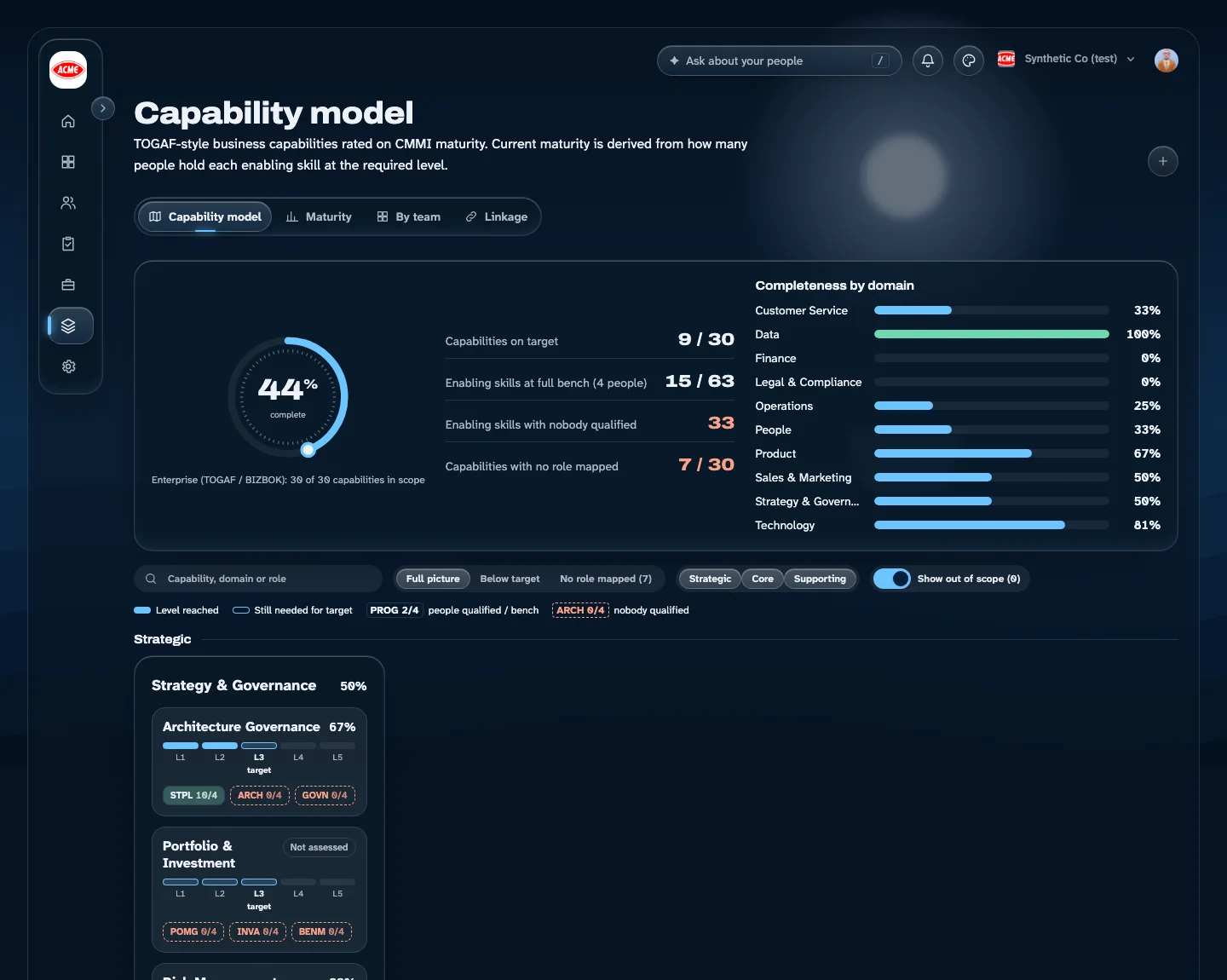
Link every capability to the skills that enable it and the roles that carry them. Roles list skills at a framework level, marked MUST, SHOULD or MAY.
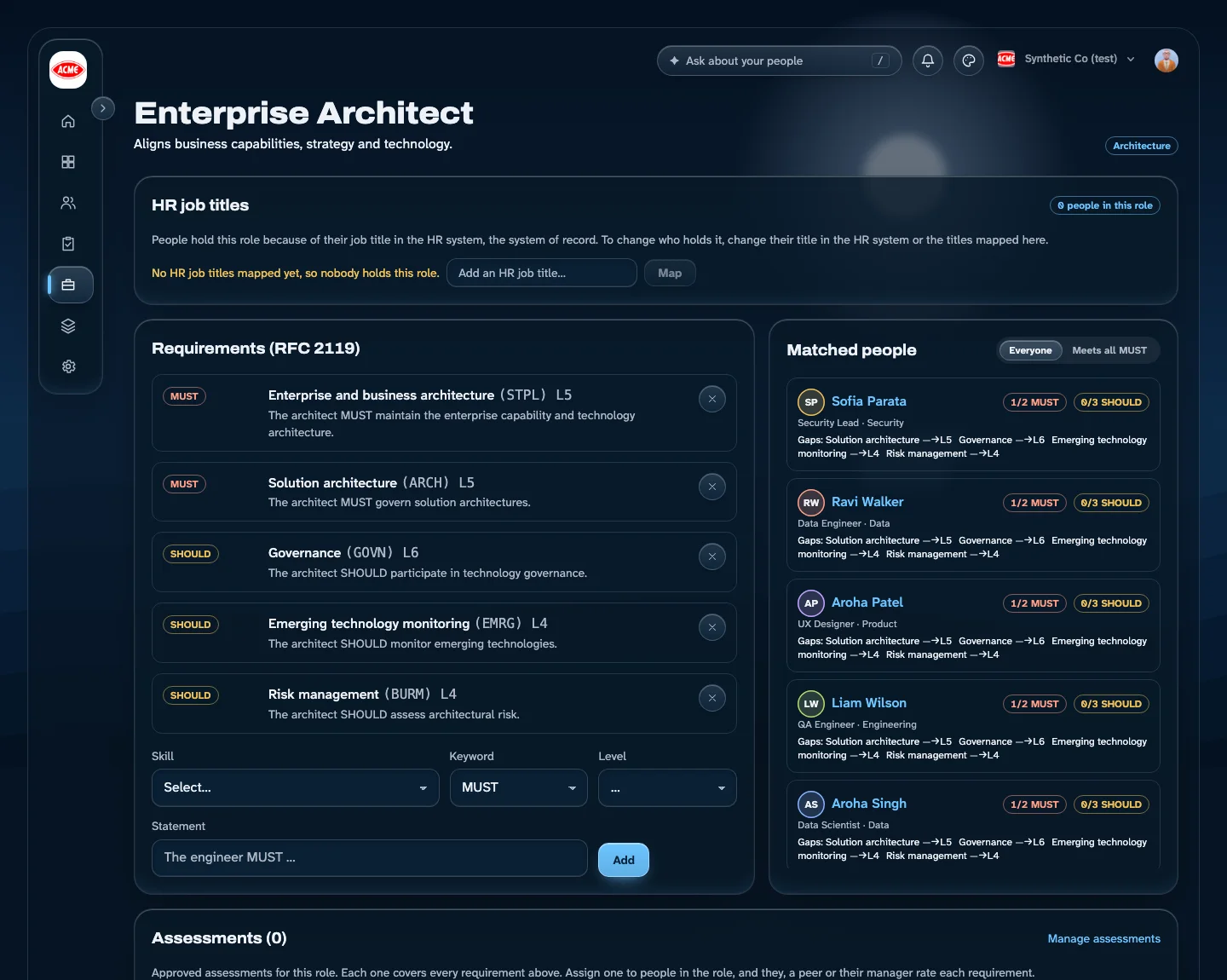
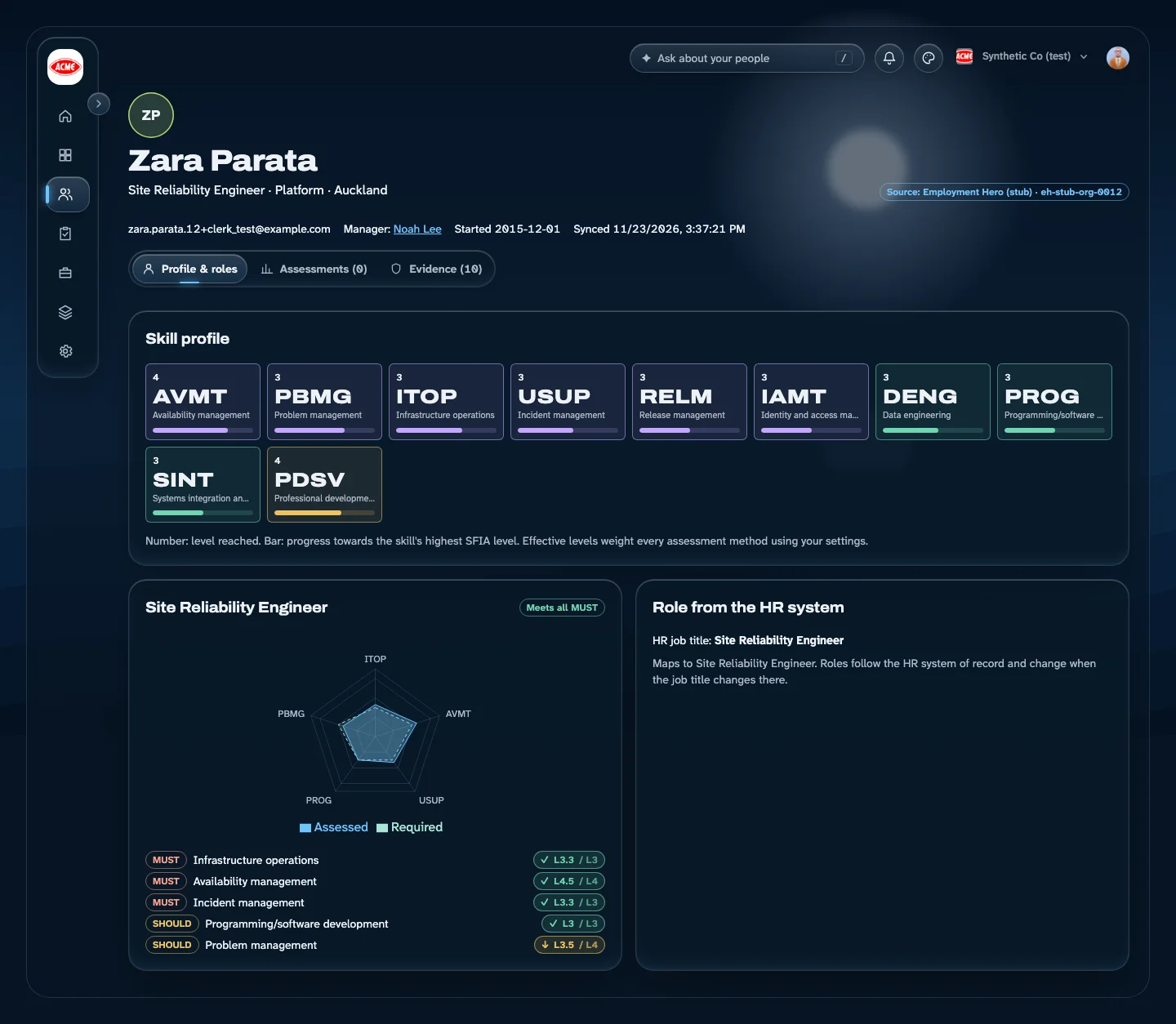
People come from your HR system, read-only. Their skill levels come from weighted self, peer, manager and evidence-based assessments, so no single opinion decides.
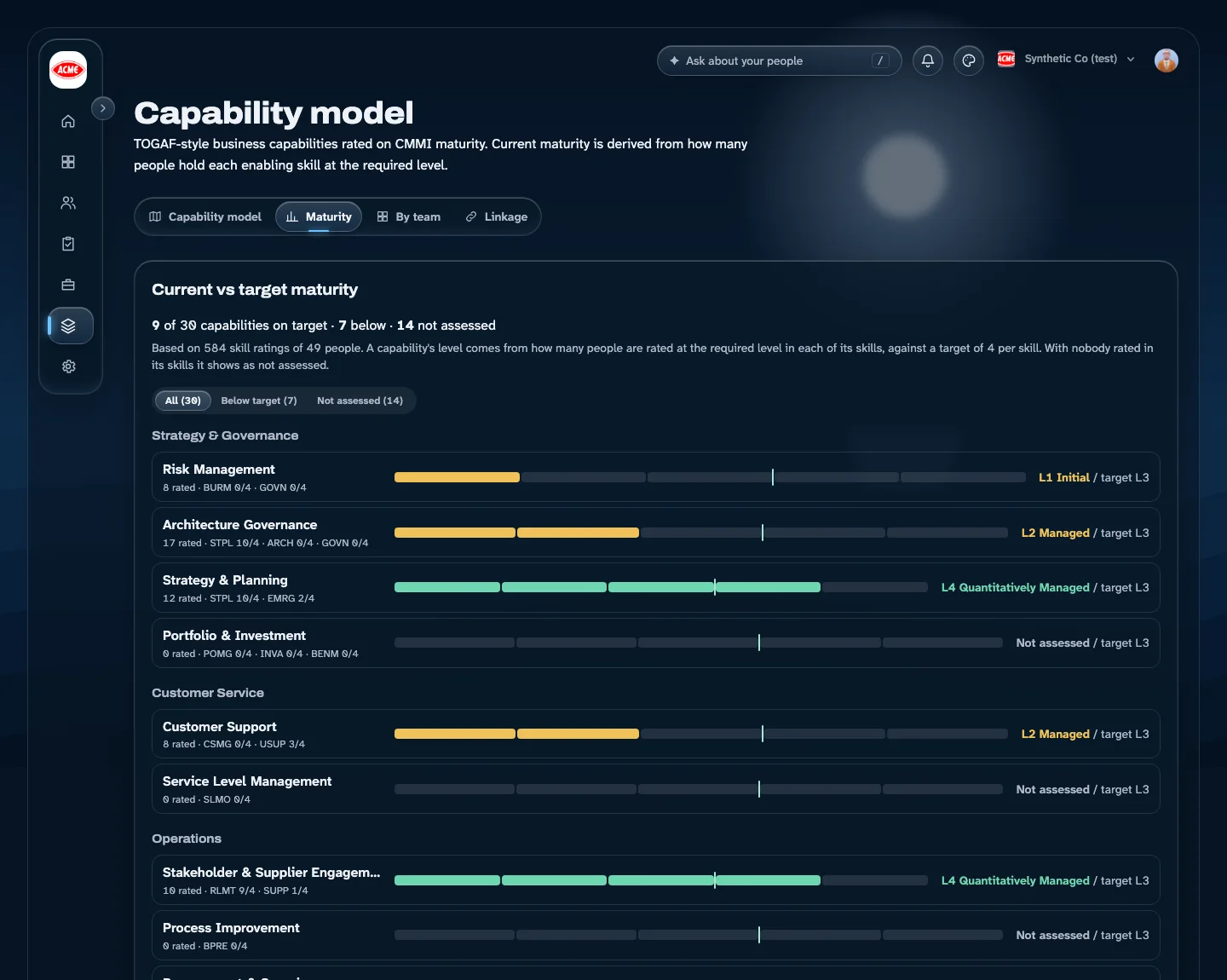
Each capability gets a maturity level from how many qualified people stand behind it. See which gap to close first, and whether to hire, train or move people.
Open any figure and see the people, skills and assessments behind it. Screens show demo data.
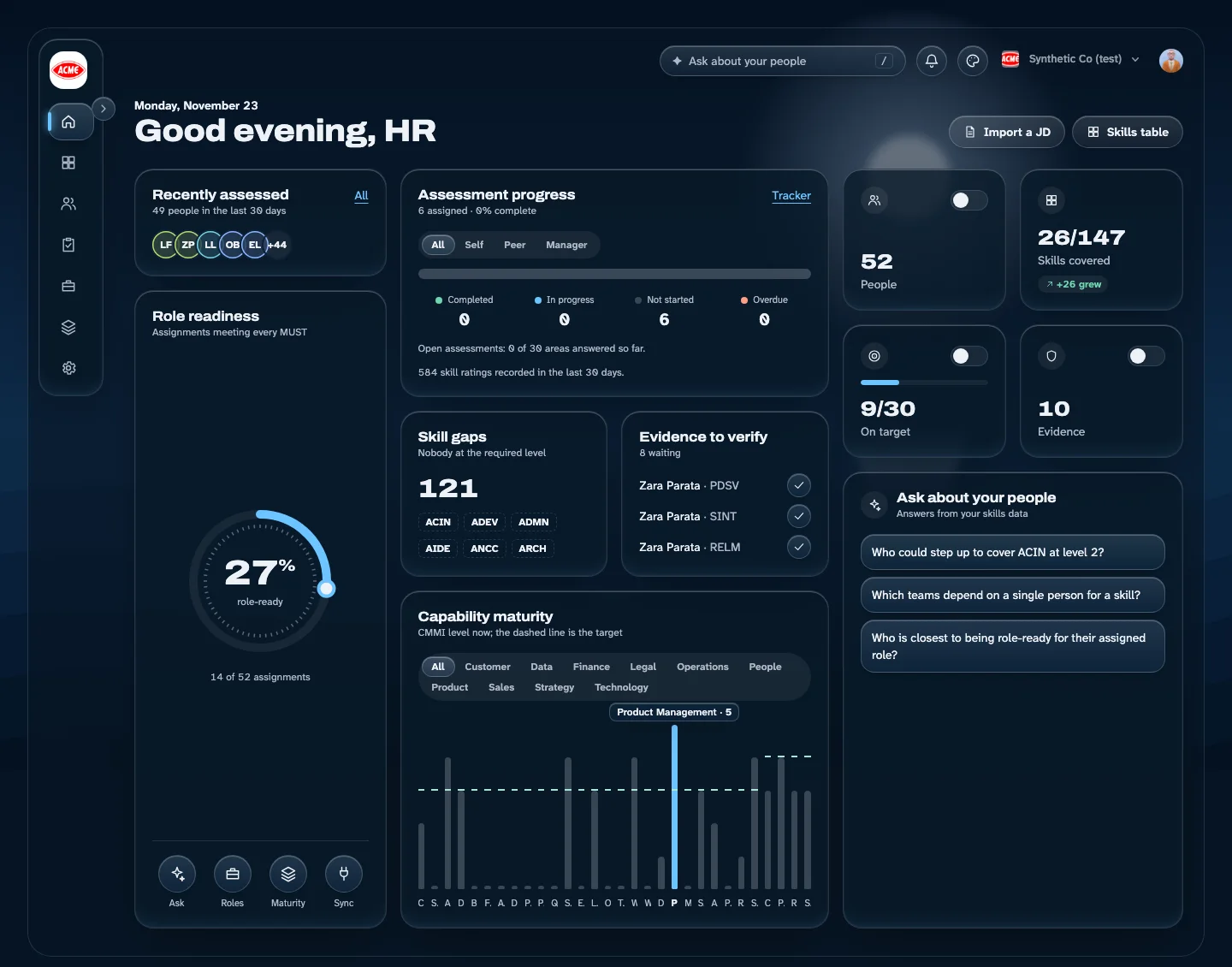
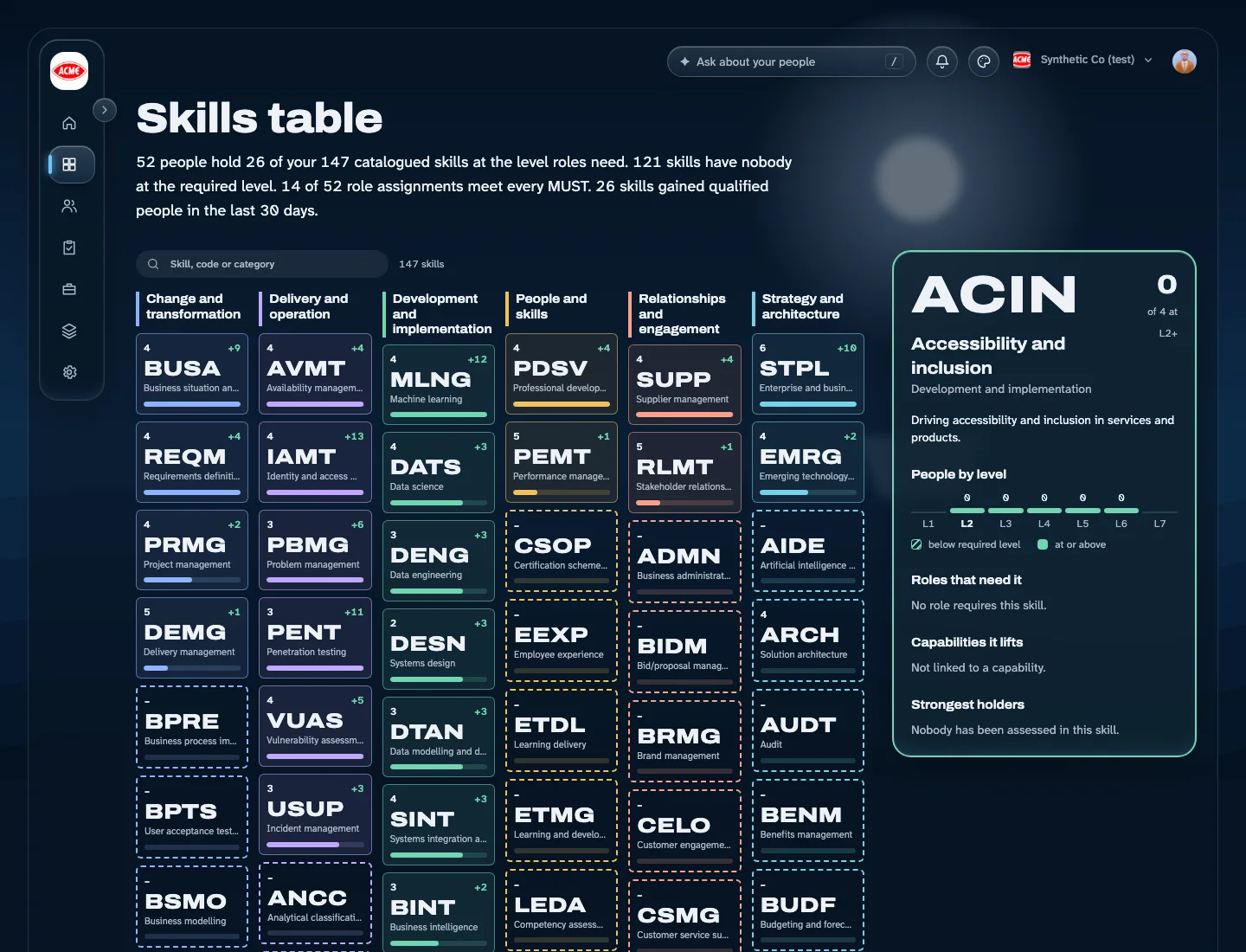
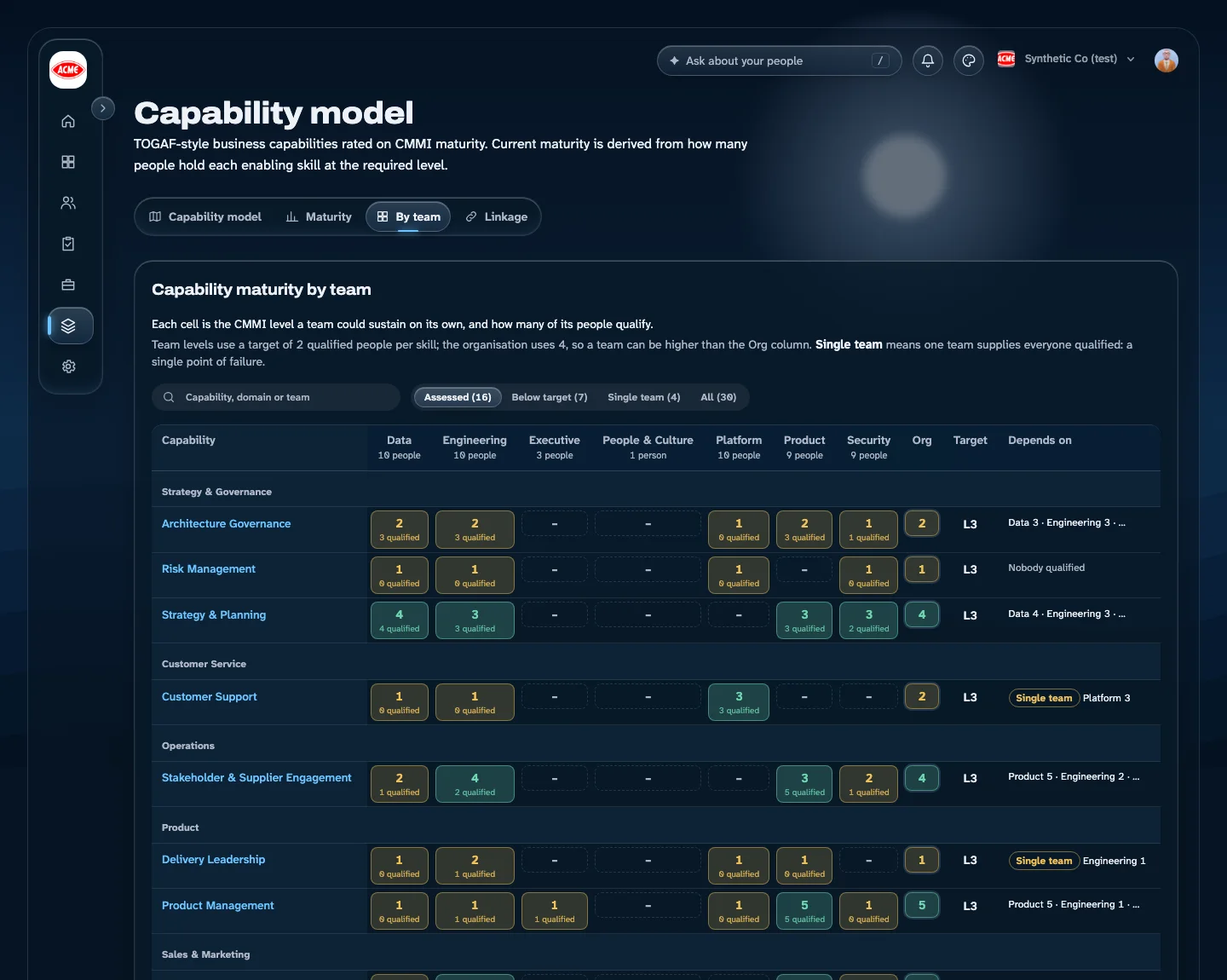
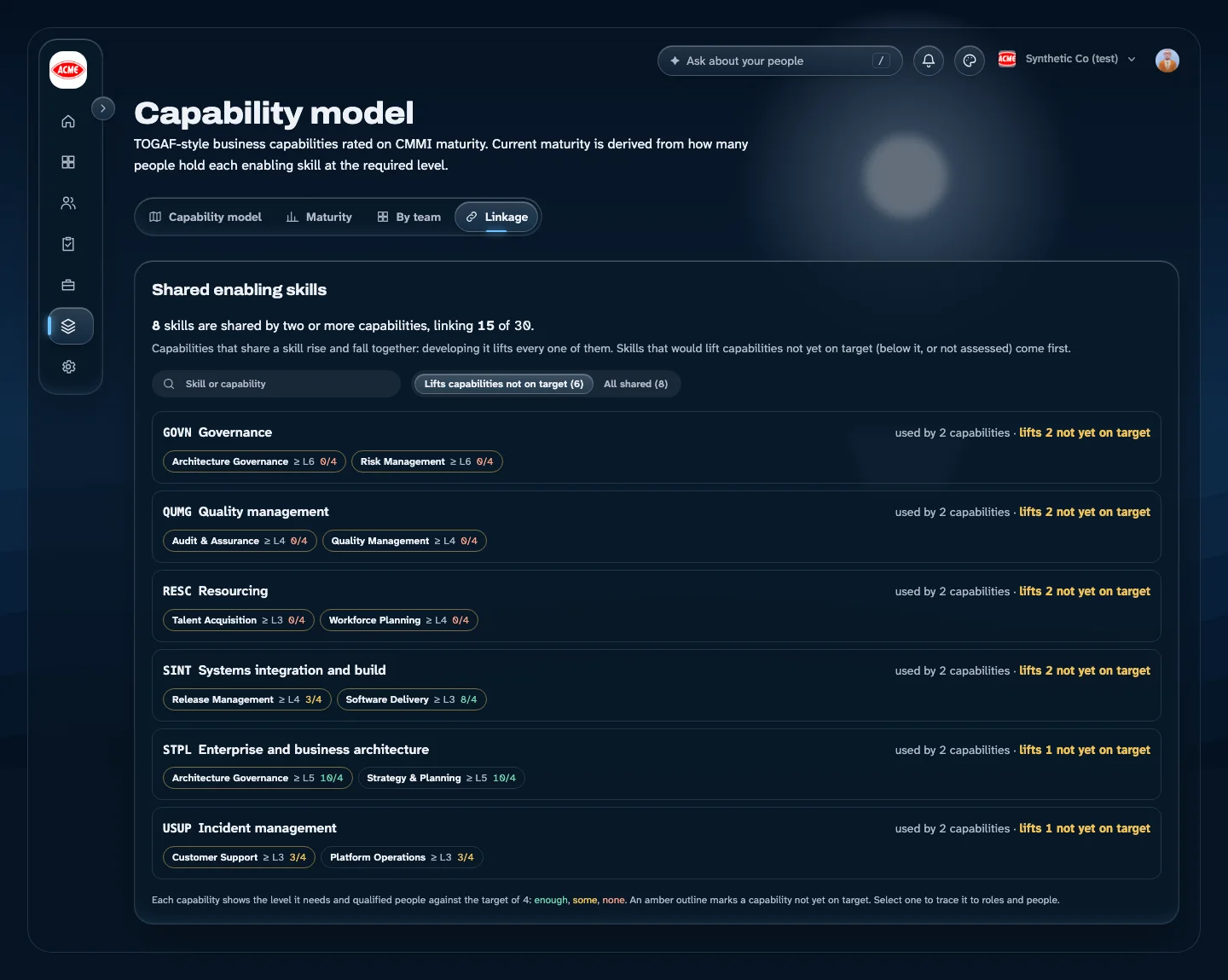
Type a question in plain language and get an answer from your own skills data. People only get answers about the staff they're allowed to see.
OrgSight reads people records and never edits them. It holds the capability data and links it to each person.
Nothing is guessed. Every weight and threshold is a setting you control, and a missing one is reported as an error.
AI is optional. It runs on your own provider key with prompts you can edit, and every call is logged with its cost.
Each organisation's data is separate. Managers see their own teams. Secrets are encrypted and can't be read back.
No. Your HR system stays the system of record for people, job titles, teams and reporting lines. OrgSight reads them and never changes them. It holds the capability data, such as skills, assessments and evidence, and links it to each person.
Employment Hero today. Connections are built on a small adapter, so others can be added. A built-in source of synthetic staff lets you try OrgSight before connecting anything.
SFIA 9 for skills and levels, and ESCO for suggesting roles. Your own HR job titles are mapped to standard roles. Maturity is reported on the CMMI scale, over a TOGAF-style capability map. SFIA is imported under your organisation's own SFIA licence.
The skills catalogue today is SFIA, which covers digital, data and technology work. If most of your roles sit outside that, talk to us about the framework you need before you start.
From bench strength. For each skill a capability depends on, OrgSight counts how many people are qualified at the required level against a target. Coverage thresholds that you control turn that into a level. A capability nobody has been assessed for shows as not assessed, never as level 1.
A person's level in a skill is a weighted mean of the latest assessment from each assessor and method: self, peer, direct report, manager, evidence review, certification and CV. You set the weights. By default a manager's review counts for more than a self-assessment, and evidence counts most.
No. The AI features are optional. When you turn them on they run through your own AI provider account, with prompts you can edit, and every request is logged with its cost.
Administrators see everything in their organisation. Everyone else sees their own record and the people who report to them. Each organisation's data is kept separate from every other's.
We'll connect a trial to your HR system, or to synthetic data, and walk you through what it shows.
Book a demo Talk to us